Showing posts with label ethnic actor rule. Show all posts

November 21, 2016

The Crow: Wicked Prayer

In The Crow: Wicked Prayer, John Connor comes back from the dead as the world's lamest mime in an attempt to stop Angel from having sex with Tara "New-FOUND-land" Reid in order to become Satan, while Dennis Hopper speaks in offensive gangsta patois in his most embarrassing performance of the last five minutes.

Now the original Crow really wasn't that good. I'll pause for a moment while all the goths in the audience immediately cut themselves in rage. (That's why I don't mind insulting goths. They'll hurt themselves instead of me.) Okay, now calm down, turn down the Robert Smith record, and listen to your old pal Carl Eusebius while contemplating the meaninglessness of it all as you crawl in your skin or whatever. The Crow was carried past its weak script and threadbare characters by a charismatic lead. It's got great visuals, fine performances by genre veterans Winston Zeddemore, Kurn, and Luther, and an effective pop soundtrack for its time. It's about a gang of criminals that murder Bruce Lee's Son and his girlfriend. Lee Jr. is so badass that he is resurrected a year later by the titular avian to bring the pain to those responsible. (Girlfriend, despite being raped and dying more slowly and painfully than Lee Jr., lacks the requisite penis necessary for being spectrally reanimated by a bird.) Not complicated or deep, but artistically shot and skillfully done, the film was anchored by an intense if not especially accomplished central performance. All in all, not a bad way to spend 100 minutes.

And Bai Ling doesn't even have to take her clothes off.

The Crow: Wicked Prayer is the third (yes, third) sequel to a film that died along with its star. Lacking any identity of its own, it alternately shamelessly apes the original film and totally undercuts it. Wisely, the filmmakers elected to steal the weakest elements of the original while jettisoning all the artistry and charisma that made it work. So the movie takes place in the American southwest instead of an unnamed Rust Belt city where it's constantly night and almost always raining. (Why yes, the original Crow was directed by Alex Proyas. How did you know?) That's right, a revenant dressed entirely in black and wearing white face-paint is wandering around the goddamn desert in the full light of day. Oh, and instead of Bruce Lee's Son, they got the charisma-free John Connor, who somehow became a worse actor as he grew up. I'm beginning to doubt that he's going to save us from the machine overlords.

This movie does not have fine performances. Instead, it has Bunny Lebowski showing everyone that she's just as terrible playing a brain-dead hillbilly slut as she was playing a brilliant archeologist, and also that she's not anywhere near as weirdly exotic and sexy as Bai Ling. When you make a clothed Bai Ling's acting look good by comparison, you need to re-think your career choice. It also has Angel doing the worst over-the-top Jack Nicholson impersonation this side of Christian Slater. I guess the default setting for your typical bad actor who's getting no direction and playing a character with no backstory, motivation, or recognizably human emotion is to "do Jack", when what they really oughtta do is to do Cage.

The plot of Wicked Prayer is...well, it's the same as the plot of The Crow, really, only dumber and immensely moar confusing. We start with Angel breaking out of his prison chain gang. In his quest to become Satan (incidentally, the career my guidance counselor suggested for me in high school), Angel gets his old gang together: Bunny Lebowski, Tank, Washed-Up MMA Champion, and That Guy I've Seen Somewhere. Being the worst Satanists ever, they capture a Catholic priest and douse him with gasoline and then just leave, without telling him his mother sucks cocks in Hell or anything. They go to the podunk town that John Connor and his hot Quebecois girlfriend are just about to leave on account of some Indian-white miner tension that never has any impact on the events to come. The gang gets one look at JC's godawful hairstyle and hangs both him and his French-Canadian squeeze, but not before Bunny cuts out the latter's (obviously fake plastic) eyeballs and sticks them into her own noggin. (Needless to say, the movie can't afford a shot of Bunny putting these clearly bogus orbs into her face, so you'll just have to trust the movie that this happens.) So now she can see the future, or the past, or something, and yes, Bunny Lebowski has the creepy witch/villain's girlfriend role that Bai Ling had in the original, though they drop the whole incest angle because, hey, that was bizarre and memorable and we'll have none of that in this movie, thank you very much. JC tries in vain to emote impotent rage and crushing sadness after Bunny stabs his Quebecois Indian girlfriend, and he's so bad at it that Angel kills him.

After Tank and W-UMMAC colossally fail at their simple task of "take the corpses into the desert and burn them", JC comes back to life, this time without waiting 3 days. After dragging his girlfriend's corpse back to her bed, he's horrified at his reflection (even though he was hanged so he doesn't even have a mark on his face) and tries to shoot himself, to find that he's now an indestructible zombie. So of course he paints his face in a terrible imitation of Bruce Lee's Son.

Now I know what you're thinking: Did he fire six shots, or only five? I mean, you're thinking, "Gee Carl Eusebius, you sexy beast you, this sure sounds an awful lot like a shitty rehash of the original." And you'd be right, of course. I am damn sexy. But now the movie introduces its original elements, which are even more terrible than its rip-offs. JC, you see, doesn't wanna be a warrior. He hates his powers, doesn't seem to desire revenge, and spends much of the movie whining about being brought back to life. "I'm afraid of what I've become." Uh...why? We're 45 minutes into the film's expansive 99- minute running time, and you've done jack shit! What exactly have you become? At one point he even says, "I wanna die." What the fuck kind of undead avenger is this guy? I kept waiting for the Crow to take its power back. Caw! God, what a pussy! Caw! Go back to the grave, shitnugget! Caw!

Finally, almost halfway through the film, JC confronts Guy I've Seen Somewhere, who understandably is less than intimidated by JC's bad make-up and petulant-teenager glare. When Bruce Lee's Son looked at his killers before he brought the pain, he was genuinely disturbing. The rage was seething and intense, but also cold and distant, as if the horrors that awaited these men were inevitable. John Connor looks like Mom just told him he can't go out on Friday night. I can't stress enough how terrible JC is in this movie. The film never really had a chance to work, but he absolutely torpedoes it with Costnerian finesse, alternately wildly overacting and grumbling out his lines like he's annoyed with the director for pointing the camera at him. He doesn't project anywhere near the emotion, charisma, and badassery necessary to pull off a man so hungry for vengeance that even death itself can't stop him. And he's done no favors by being a foot shorter and proportionally smaller than all of his enemies, especially Angel, which the director doesn't even attempt to hide. If you're going to be a short guy kicking everybody's ass on film, you either have to be the scrappy underdog who wins through guile rather than brute force, or Joe Pesci. Because otherwise, it looks ridiculous onscreen.

The movie then rushes to get through the rest of its "plot". JC somewhat implausibly defeats W-UMMAC in a martial arts fight after W-UMMAC starts bashing up a party with a baseball bat (along with the film's continuity, as the mask he's wearing alternately appears and disappears between shots). Bunny somehow knows the Crow is JC's weakness, despite none of the villains even knowing he was back from the grave until this scene, so they kill the Crow, making our whiny hero even more pathetic and ineffective and so Angel kicks his ass. Then they just leave again, because if they kill him while he's powerless, then the bad guys would win and the movie would be over. They reach the main Satanic temple run by Dennis Hopper, who marries the unholy couple and then gets stabbed by Bunny for reasons that are explained in a flashback that absolutely no one on Earth cares about at this point. Angel becomes Satan, but he has to boink Bunny to make it permanent, because otherwise the bad guys would win and the movie would be over. JC shows up, but he still sucks so Angel kicks his ass again, while a bunch of JC's Indian friends kill Tank in a scene so filled with boredom you'll glance over at the screen and sigh wearily. For his part, Angel, instead of taking Bunny right then and there in the Satanic temple and making himself permanently Satan--I mean, it's a Satanic temple, isn't it?--decides he and Bunny have to drive somewhere else entirely in order to do the deed. Because if they just did it right now the bad guys would--well, you get the picture.

JC, despite being crucified by SatAngel (he's playing "Jimmy Cuervo" in this movie, so the ham-handed Christ allegory is the movie's, not mine) is Only Resting, so he jumps in his stolen car and gives pursuit. (Things a reanimated spirit should never do: drive a car.) He catches up to Angel and gets his ass kicked yet again, because he's powerless without the Crow and Angel is Satan. (Ignore the fact that JC got pretty thrashed by W-UMMAC when he still had the Crow's power, at least until the script said it was time for him to win.) Then Danny Trejo joins the illustrious ranks of Hispanic Guys Playing American Indians Because Who'll Know the Difference, Right? when he leads an embarrassing "Indian" dance to bring the Crow back to life, even though the movie earlier claimed that the Crow's power comes from the Christian God. Okay, the original film's mythology was pretty vague, but it was pretty clearly not Judeo-Christian. We're a long way from the original's "Stop me if you've heard this one: Jesus Christ walks into a hotel. He hands the innkeeper three nails and asks, 'Can you put me up for the night?'" Okay, movie, just go back to aping the first film. Yes, you suck at that, too, but it's far better than your attempts at being original.

Blah blah, the Crow's back, JC starts no-selling Angel's attacks and kills him, and the Sun comes up, which I guess makes Bunny blind since now her plastic eyeballs don't work anymore(?). The End.

The Crow: Wicked Prayer is a shitty cash-in on the tragic death of a break-out movie star that showcases the worst of everyone involved in making it, including people that we know are capable of better and Tara Reid. Fuck this movie with seventeen crow beaks.

December 16, 2014

The Conqueror

Genghis Khan. The man who forged a perpetually-warring people made up exclusively of battle-tested warriors into an unstoppable juggernaut of pain that created the world's largest land-based empire, with nothing more than his unmatched charisma and elevation of loyalty and skill above family relations.

It's 1956, and you're making a movie about the most feared man in world history. Who would you cast as this world-spanning conqueror, this man who destroyed cities, massacred their inhabitants, and fathered more illegitimate children than an entire session of the US Congress? Yul Brynner, that's who, because Yul Brynner is fucking rad. He's a charismatic, imposing, powerful presence onscreen, and he's at least part Mongolian. Not to mention that in that very same year of 1956, his magnificently sculpted torso blew Charles "From my cold dead hands" Heston off the screen in The Ten Commandments. Give the man a sword and a horse and unleash him on an unsuspecting steppe.

What you don't do is put John fucking Wayne in bad yellowface and have him romance a Central Asian "Tartar" woman so Aryan Dr. Strangelove's hand would be compelled to salute her.

The Conqueror is the story of the worst casting choice since some jackass decided to put Clooney in the Batsuit. I know you think Kevin Costner's complete lack of even an attempt to drop his completely inappropriate accent for playing Robin Hood was atrocious and unforgiveable, and you're right of course, because Kevin Costner sucks harder than a Republican Congressman in a skeezy truckstop men's room. But just wait until you hear Genghis fucking Khan talk about his blood boiling in lust for a woman he's about to kidnap and force into his bed in John Wayne's all-American cowboy drawl. Be sure to read the following sentences aloud in your best Wayne impression:

"While I have fingers to grasp a sword, and eyes to see yer cowardly faces, yer treacherous heads will nawt be safe on yer shoulders. For I am Temoojin, the conqueror. No prison can hold me, no army can defeat me, pilgrim."

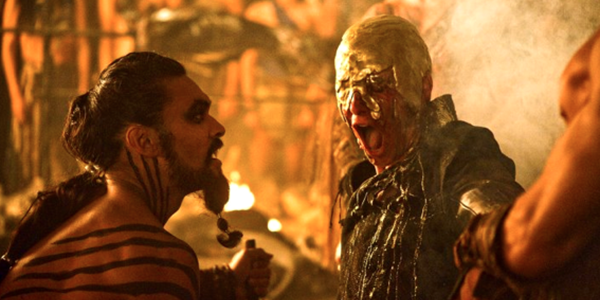
The film details a mere few days it seems in the life of Khal Drogo Genghis Khan as he was just beginning his rise to dominance of all Mongolia. But really it's a shitty remake of Romeo and Juliet, only here Romeo kidnaps Juliet and holds her prisoner until she grows to love him while., avoiding her attempts to murder him with a sword. Because whitebread monogamous marital love is what the Mongols were all about.

Genghis Khan (John Wayne!), known in the film by his birth name Temujin, espies his rival Targutai, chief of the Merkit tribe, and rides forth to challenge him in that "by whose leave do you cross my lands?" ye olde bullshit language that reflects how precisely no one has spoken ever. He immediately becomes enchanted with Targutai's soon-to-be-third-wife Bortai (Susan Hayward). Bortai, for her part, is having none of Temujin, since she's a Capulet Tartar and he's a Montague Mongol, and her father killed his father and yadda yadda. Temujin contemplates attacking Targutai's caravan and seizing Bortai for himself, but his right-hand man Jamuga (Mexican actor Pedro Armendáriz, the only actor in the entire cast who isn't of the Master Race) persuades him to return to their village to gather moar men. They head back and recruit a raiding party. I guess Temujin doesn't bother to tell them who or what they're raiding until they're just about to ambush the caravan, since upon finding out the target is the Merkit chief, the fearsome Mongol warriors are suddenly afraid to attack, lest the larger and more powerful Merkit tribe retaliate later. But Temujin gives a speech that won't have Henry V looking over his shoulder (including calling the warriors "women" for their cowardice, as if the Mongols considered their women weak) and the raid is on.

The Mongols win, but not before Targutai decides that discretion is the better part of valor and makes to beat feet. He tells Bortai to come with, but she's all "Runnin' is fer punks" and he's all "Then I'ma leave yo' ass" and she's all "Well do it, tough guy!" and he's all "Smell ya later!" He bravely runs away, away, and Temujin gets him dead to rights but doesn't kill him from behind, because that's how Genghis Khan rolled. He just taunts him for his failure and then lets him escape. Now, I could see Genghis Khan making fun of his cowardly defeated enemy in front of his victorious raiding party...and then brutally slaughtering him. I mean, this is a man who burned entire cities to the ground to prove a point. No way he's letting his enemy come back to fight another day.

Bortai remains defiant, even threatening Temujin with death at her father's hands, and Temujin somewhat unrealistically responds by not raping her right then and there, since he's fucking Genghis Khan. I know it's 1956, but if you aren't even going to fade to black at this point, why even make a movie with the Mongols as protagonists? Didn't the filmmakers give a toss about even a semblance of historical accuracy?

Oh right, the John-Wayne-as-Genghis-Khan-thing. Nevermind.

He does rip her shirt off, though, as the movie's romantic music plays(!). He takes her back to the village, and stuff happens, and then he takes her into his yurt to put the make on her, and she says she'll just lie there and do nothing. Temujin becomes frustrated and leaves, because Genghis Khan would never force himself on an unwilling partner. But wait, this movie is clearly '50s in its heart. Isn't his wife lying there and doing nothing just what he'd want? *rimshot*

Bortai then gets Jamuga to come into her yurt, which is frankly the worst possible idea for both of them no matter how you look at it. Jamuga declares his loyalty to Temujin, Bortai threatens to give away the compromising position he's currently in (somehow forgetting that the situation looks no better for her), Jamuga starts to choke a bitch, and then Targutai rescues us from this godawful scene by raiding the village. More stilted action scenes follow. Targutai stabs his spear through the front door of Temujin's yurt, which would have done the Mongol leader in but for the fact that he isn't standing directly on the other side of it at the time. Temujin then exits through another part of the yurt and easily kacks Targutai with a spear (causing Targutai's horse to fall over?) and even more easily captures the fleeing Bortai. Some random Merkits pursue (apparently seeing their leader cut down didn't affect their morale at all), and Temujin cunningly evades them by hiding himself and Bortai in a cleft in the rock in full view of the Merkits. But the script says the Merkits don't see them, so they ride by, leaving Bortai to accept Temujin's advances, because the script says she loves him now(?), at least if the movie's romantic music is to be believed. I mean, nothing says sexy-time like lying on a bare rock face, amirite, ladies? Fade to black.

Next day, Temujin and his new wife return to the village. A guy challenges Temujin's leadership, so Temujin lays him out with a patented John Wayne haymaker. Which is exactly how Genghis Khan would respond to a challenge to his leadership.

He then decides to destroy the Tartars by enlisting the aid of one Wang Khan. Bortai reveals she still hates Temujin and clumsily tries to sword-murder him, an attack he easily avoids. This only further inflames his desire for her, but once again he won't force himself on her. He does slap her for being uppity when he claims she'll eventually hate him so much that she'll love him (lolwut), but then he looks regretful about it, and I secretly hoped the real Genghis Khan would rise from the grave as a kickass zombie Mongol and strangle Wayne to death on screen.

The Mongols go to Wang Khan's city, Urga, and man, the parade of white people in shitty brown face paint and terrible Fu Manchus just keeps getting longer. It turns out Wang Khan isn't the real power in the city of Urga anymore; instead it's his advisor Shaman. Temujin quickly groks to this, and then it's time for a few very long and very boring "exotic" dance sequences. After Temujin smirks approvingly at the slinky, scantily-clad dancing women, Bortai's jealousy makes her doff her coat to reveal a silver-sequined bra (how long has she been wearing that?) and do her own sword dance. Suddenly, just when we most expect it, she hurls one of the swords at Temujin. Look, if you aren't the Governator, you can't throw a fucking sword. Not to mention that I doubt the mousy Hayward could even lift a real sword, much lest hurl it 20 feet through the air.

Shaman agrees to support Temujin against the Tartars, but the latter strike first when Bortai's father Kumlek seizes the Mongols' village just before Temujin and his party arrive. Temujin gets shot with an arrow and Bortai escapes to rejoin her father. She helps Jamuga escape from her father's captivity, but as Jamuga should've known, the only reason for the ease of his escape was that Bortai and a party of men are tracking him to the rebel base Temujin. The future Genghis Khan is captured and hauled in front of Kumlek with his arms tied to a piece of wood across his back in perhaps the most jaw-dropping Christ imagery in film history. Later, Bortai, apparently now back in love with him (wha....?), helps Temujin escape. People do a lot of escaping in this movie. Temujin decides his earlier wound doesn't bother him anymore and kills few guys for good measure before taking his leave.

Temujin returns to camp and prepares for the big fight with the Tartars, but Shaman appears and tells him of Wang Khan's treachery: He's not sending the promised army, leaving the Mongols to fight alone. Shaman, who is disgusted, simply disgusted by this brazen act of treachery, promises to open the gates of Urga to Temujin, who can murderize Wang and seize the army for himself. Shaman also says that this is an obvious double-cross and that he himself is actually behind the plot. Okay, I may have added that last part.

Shaman does open the gates, and Temujin does seize the city. Shaman finds Wang in bed and stabs him just as Temujin enters, but since he stabs him in the stomach rather than, say, the throat or head or chest or anywhere instantly fatal, Wang is able to reveal that Shaman told him to betray Temujin in the first place. So Temujin cuts down Shaman (tastefully off-screen, of course). Um...but didn't Temujin earlier believe Wang betrayed him? Why does he suddenly trust Wang's word now? Shaman opened the gates to city as promised, and earlier Temujin seemed fine with Shaman's plot to murder Wang and throw his support behind Temujin. Fuck it, I don't care, let's just get to the end.

Temujin takes over Wang's army and marches against the Tartars. Bortai saves Jamuga from her father's torture and confesses her willingness to betray her father and her people for Temujin's. People do a lot of betraying in this movie. For his part, Temujin infiltrates the Tartar camp at night and then immediately gives away the game by calling out for Bortai. She runs to him, because love, and Temujin suspects Jamuga of shenanigans with her and tries to kill him for it. (He doesn't seem angry with her, though.) Before he can succeed, he has to let Jamuga alone because the climax of the film is about to start. Temujin pulls Bortai close before he marches forth to take revenge for his father's murder by murdering her father, and she seems pretty okay with it. Blah blah big battle, with Temujin in the thick of things while Kumlek sits on a hill and watches. Because warrior chiefs don't actually fight in battles. Temujin eventually sights his foe and charges after him, who bravely runs away, away. Temujin quickly unhorses and murders his unresisting enemy, the only time he does anything remotely like Genghis Khan. Still, not exactly pouring molten gold onto the bastard's head, is it? The film ends with Jamuga, afraid Temujin will always suspect him of treachery even though he has at no point done anything treacherous, requesting to be executed(?) and Temujin granting the request(!), with Jamuga's voiceover(!!) telling us that Genghis Khan's descendents would "rule half the world". Thankfully, mercifully, the credits roll.

The Conqueror is long, boring, and shitty. I guess you could say that, in the end, The Conqueror...

*sunglasses*

...was the one who got conquered.

YYYYYYYEEEEEEEEEAAAAAAAAAHHHHHHHHHHHH!

The time is ripe for a Hollywood action movie about Genghis Khan. I mean, we've already had Alexander the Great, Action! Robin Hood, Hercules, Richard I, Action! Dracula, Hercules again...why not the greatest conqueror of them all?

But who, you ask, would play The Conqueror, now that Yul Brynner has ascended to Mount Olympus to take his place among the other gods? Oh, I think we all know who.....

August 22, 2012

EJO Review: Wolfen

Next up on our Edward James Olmos series is a real disappointment. There aren't many good werewolf films outside of Universal's Wolfman series, and Wolfen (1981) was supposed to be one of good ones. Sadly, not only does it not rank with An American Werewolf in London or The Howling, or even Wolf (werewolf Jack Nicholson!), but it's actually rather terrible. And it's not even a werewolf movie!

The film opens with a monster attack sequence that the makers of Predator clearly saw. The wolfen-point-of-view shots were undoubtedly the inspiration for the Predator's infrared vision. Since I plan to rip this movie pretty hard, it's nice to start off with something good, and the film deserves credit for its pioneering monster POV. Thank you, Wolfen; Predator would've been slightly less awesome without you, so you weren't a complete waste of celluloid. The shots of run-down New York City are also effective, atmospheric, and creepy. I miss the New York that gave us films like this and Escape from New York. Where can we find a rotting cesspool of crime and decay to film now? Thank God there's still Detroit.

Anywho, after taking way too long stalking people (and getting so close to them that you can't believe it wouldn't be seen, or heard, or smelled, a recurring problem with the stalking sequences), the wolfen kills a rich, important muckety-muck and his wife, though not before killing their chauffeur, because the black guy always has to die first. Solving this murder is so important to the city of New York that they bring in a fat, lazy drunk specially to handle the case. Said fat, lazy drunk is played by Emmy-award winner Albert Finney, who does an excellent job playing a fat, lazy drunk, and not just because he's English. In fact, despite occasionally missing with his American accent, Finney gives the film's best performance (apart from God's own, natch), and I'm thankful he was chosen for this role rather than America's home-grown go-to guy for the role of fat, lazy drunk in the late '70s and early '80s, Joe Don Baker. The other performances range from adequate (Gregory Hines(!) as Finney's coroner pal, Tom Noonan as a zoologist whose obsession with wolves even I find unhealthy) to jaw-droppingly awful (Diane Venora as a psychologist assigned to assist Finney, though her assistance consists entirely of sleeping with him for no reason other than they're the two leads in the film). This is also the film debut of Reginald VelJohnson, notable because it's possibly his only appearance in front of a camera not playing a cop.

Edward James Olmos is cast in this film according to the Hollywood Ethnic Actor Rule as an American Indian(!), despite the fact that he doesn't look Indian at all. You'll remember from last week that this rule allows actors in the "not WASP or black" category to freely play any ethnicity in that category, since American audiences won't know any better. He plays Eddie Holt,* a militant Indian put away by Finney's Dewey Wilson (yes, really) for killing an apple. No, I don't mean he went to prison for wanton slaughter of innocent fruit. "Apple" is apparently the American Indian version of Uncle Tom (or, to the primary audience of this blog, "banana"), that is, a ethnic minority who's sold out to the Man. Holt is so obviously set up as the werewolf that you instantly know he's not the werewolf, though it takes Olmos running naked on the beach for Dewey to figure this out. Frankly, I would've preferred that Dewey make this determination without my having to see the little Eddie. The scene has Dewey, thinking Holt is going to turn into a werewolf (it's complicated), following him to the beach where he strips naked, licks up water from a puddle in the sand (wolves drink seawater?), and runs around making growling and howling noises. While all this is going on, to absolutely no one's surprise, someone is killed by the wolfen in another part of the city, sending Dewey back to the drawing board for suspects. I admired Olmos's dedication to his art in this scene, as it must have taken serious cajones to go on camera and do the scene rather than just punching the director in the face or smiting him with a thunderbolt, and it reminds me just how prudish our society has become over the lifetime of yours truly. Still, a grown man running around pretending to be a wolf just looks silly, no matter how much gravitas the actor has or how scary the music is. It's a goofy moment played straight but impossible to take seriously, like something out of The Exorcist. Actually, "goofy moment played straight but impossible to take seriously" describes the whole of The Exorcist.

As with the previous projects, I can see why Olmos took this role. Wolfen is firmly in the vein of 1970s Western-civilization-in-decline films that portray victims of European colonization and oppression as morally superior to their conquerors. The film sets up a dichotomy between the Noble Savages (guess who they are) and the White Man Dependent on, Like, Capitalism, Man, and comes down clearly on the side of the white liberal guilt. I mean, Indians. And this is the single biggest problem with the film. It is, in fact, the reason it's a truly bad film rather than a serviceable low-key, low-FX monster flick. There is essentially only one Indian character (Holt), and more than once he gets to wax morally superior to Dewey by ponderously speechifying about how corrupt White Society is. To give you an idea of how well the Indians emerge as characters, the only other Indian has any screentime at all is credited as "Old Indian". No name, just Old Indian. We don't even find out what tribe these Indians are a part of, or even if they're from the same tribe! They're just Indians, and Indians love nature and marijuana and hate capitalism and Whitey. And the ones who don't aren't real Indians ("apples") and deserve to be murdered. The filmmakers would undoubtedly be appalled to hear that this is the subtext of their film, as I'm sure they didn't intend to treat their Indian characters as shabbily as 1960s Westerns that portrayed them as a faceless horde of identical backward savages to be mowed down by heroic white cowboys. But to quote Ken Begg, "well, you can’t not see it. I’m absolutely sure that it’s unintentional, but still, it’s kind of there anyway."

The worst example of the one-dimensional nature of the Indian characters in this film is the excruciating exposition scene near the end, in which Dewey, rather than discovering the secret of the wolfen through the White Man's Science of his detective work, has the wolfen explained to him by the Indians (again, mostly by Olmos looking righteously angry). Dewey goes to a bar full of Indians, imaginatively named the Wigwam Bar (really?), and there the Indians painstakingly explain to him what the wolfen are, why they've done what they've done, and why the White Man deserves to have it done to him. (That the wolfen have killed a number of black characters at this point goes unaddressed. I guess they're collateral damage from the wolfen's carpet bombs of justice.) Why yes, the Indians are smoking peace pipes while generic Indian chanting plays on the soundtrack.** I'm so glad you asked!

Wolfen's pacing is slow, its acting is hit (Finney, Olmos)-or-miss (Venora, the non-Finney cops and investigators), its story is a little scattershot, its kills are telegraphed (maybe they were slightly more surprising in 1981, but I doubt it), and its central monster not being a werewolf is a cheat. But all of these things could be forgiven if not for the ham-handed "message" of the film and its treatment of Indian characters as positive stereotypes every bit as offensive as the negative stereotypes it's reacting against. And then there's the ending. And I said, you find out what the wolfen are and why they're doing what they're doing, and the film clearly agrees that they have some justification. But the ending torpedoes any final hope the film had. Not because it has the wolfen offscreen teleporting from ground level to the penthouse balcony of a skyscraper, but because Dewey realises that the wise Indians are wise and that the wolfen are morally correct, and he decides they should be left to continue to murder people as they see fit. I'm serious, that's really the implication of the ending. Dewey agrees that the wolfen are right to eat the people they've chosen to eat. I can't explain to you how little sense this makes in the context of the film. It's bad enough that the makers of the film thought this, given the situation they've set up, but why does Dewey accept it? There's nothing about the character, either before or after his experiences with the wolfen, that in any way suggests he'd be okay with this. The wolfen even eat one of his friends in the movie! Dewey must've smoked some of whatever they put in those peace pipes to just accept that the wolfen have killed (including, again, a good friend of his) and will continue to kill. That, or the filmmakers allowed their own belief that the wolfen are right to impose itself on their character, regardless of whether or not the character and his experiences support that view. I'm betting on the latter.

I haven't mentioned the subplot of another entire group of investigators trying to link the murder of the rich muckety-muck to a vague, ill-defined "terrorist" group, using some kind of truth-machine that looks like whatever Egon was imaging Dana's face with in the original Ghostbusters. But that's okay, because this storyline has impact on exactly nothing, and I can't for the life of me figure out why it was included. But as I've noted, it's the film's moral failings that truly made me angry and frustrated with it. Like The Constant Gardener, the film makes its creators appears to be of the "if your cause is just, anything you do in furtherance of that cause is just" school of evil. Ends alone do not justify any and all means.

Unless the goal is to make sure there are no more Adam Sandler movies. In that case, use any means necessary.


====================================================
* How they resisted naming the character Eddie Two-Bears or something equally "Indian" I'll never know, but kudos to the filmmakers for at least avoiding this stereotype.
** Actually, the Indians give two completely different explanations for why the wolfen are killing people, but nobody ever seems to notice this.

August 17, 2012

EJO Review: American Me

Continuing our series on Edward James Olmos, we come to American Me (1992), a crime drama inspired by the life and death of the founder of La eMe, popularly known as the Mexican Mafia. American Me has been aptly described as a Chicano Godfather, and the influence of the finest gangster film of all time is obvious upon even a cursory viewing of the film. But Me is also a product of the early 90s, and it reminded me less of The Godfather and more of Abel Ferrara's King of New York (1990). Both films feature a crime lord being released from prison, becoming disgusted with the escalating violence on the outside, and attempting to go straight (or at least to mitigate the violence), and both also end darkly in terms of the main character's fate, with the suggestion that escape is hopeless and will lead to disaster for anyone attempting to do so. Each is well directed and features a strong lead performance that elevates otherwise rather pedestrian material. In the case of Me, Edward James Olmos directs himself in the lead performance, his debut as a feature director. His direction is sure-handed and confident without being overblown or preachy, including a great shot from the perspective of a man being carried away to be beaten. The choice to direct himself is a good one, since the quiet, low-key performance of Olmos the actor well complements the quiet, low-key style of Olmos the director. There is a well-cut sequence of the main character having sex with a woman (for the first time, as he has been in prison since he was a teen-ager) inter-cut with the brutal sexual assault of the son of a mob boss as a statement of La eMe's power. The love interest is mostly believable in the role; rather than being a typical Hollywood beauty, she has the look and affect of a woman who might be drawn to the social ineptness and strange sort of innocence one might find in a man who's been locked up his whole life.

Now I appreciate both subtle acting and subtle direction, and I'll take those before over-acting and overly busy, trick-shot directing every time, but the film could have used a little more energy, and none of the other characters really emerges from the background of various gang-bangers calling each other ese (including Cary Hiroyuki-Tagawa, here exemplifying the Hollywood Ethnic Actor Rule* playing a Mexican(!) gangster). The story of the godfather of the Mexican Mafia is never quite as compelling as it should be. Olmos's performance is too subtle to overcome the weaknesses of the script, and no one else in the cast steps up to lend some fire to a story that could use a little heat. (A young John Leguizamo would've livened things up a bit.) The language and rhythm of the film is initially appealing and (to this untrained ear) reasonably authentic--I particularly appreciated the mixed patois of Spanish and English, often even in the same sentence--but after hearing the words ese, homes, and vato about 300 times, it becomes a little tiresome. There's even one Chicano character who, upon taking a hit of his illegal drug of choice, declares it "good shit, man". One wonders what Olmos, trying to make a film in which Mexican-Americans emerge as real people and not caricatures, thought when he came across this moldy Hollywood stereotype in the script.

The best scenes are those inside the prison, showing how a person can run a multi-million dollar drug business from inside the walls. Things are much less interesting outside prison, and the movie seems to realize this as the Olmos character, after spending almost half the movie in prison before being released, ends up back in prison for the final fifteen minutes or so. The film contains many of the themes and ideas characteristic of Olmos's work: white racism against Chicanos, the hopelessness and despair brought on by the poverty and disempowerment of the barrio, a respected leader's attempt to reform a corrupt subset of society and the futility of such attempts, and the lack of vision of the oppressed to try for something better. The female lead, after ending her relationship with the Olmos character, declares that there's no hope for the children of the barrios as long as people like him exist. Olmos's work, while acknowledging and criticizing the enormous barriers to Chicano progress, refuses to apologize for or elide the horrors wrought by the gangs. It may be understandable that they do what they do, but it is not excusable or acceptable. If it seems that Olmos's message is contradictory--that the conditions in the barrios make life outside of criminality impossible for young Chicano men while still holding them responsible for their criminal behavior--it is a reflection of the reality of life in the barrios. This is not a weakness of his work, but a strength.

And that's probably part of why I appreciated this film, even if I'm not especially fond of it. Overall, it's a serviceable early 1990s gritty crime drama, well directed and acted but not especially exciting or memorable. Unlike its inspiration The Godfather, this is not the sort of film you can show to anyone. Recommended for fans of gangster films and Edward James Olmos fans only.**

============================================================
* This is the rule based on the understanding that American audiences classify people into three ethnic groups: WASP, black, and neither WASP nor black. Actors can freely play any role within their group. This rule allows Chinese actress Joan Chen to play an American Indian in On Deadly Ground, Mexican actor Ricardo Montalbán to play Sikh Indian Khan in Star Trek (look it up!), and Jewish actress Jenette Goldstein to play Vasquez(!) in Aliens. (To be fair, Vasquez will inevitably be played by Michelle Rodriguez, whose agent you call when you're casting the role of "macho angry Hispanic babe", in an upcoming remake of Aliens. Now that Alien has been remade (inexplicably named Prometheus), I assume an Aliens remake is already in the works.) Related rules: The Black Character Must Die First; Lead Actors Are White
** Fortunately, I happen to be both.